
























Ottawa’s August announcement of its intention to fast-track the West Coast pipeline proposal marks the latest in a series of interventions designed to facilitate oil and gas expansion in Canada. Paired with its recent push for major pension funds to invest in new oil and gas infrastructure, the establishment of the Canada Strong Fund, and other measures, Canada’s federal government is elevating oil and gas expansion as a nation-building endeavour. More than winning residual demand for oil and gas, the country appears to be betting on demand growth in key Asian markets, encouraged by extraordinary market conditions today.
Yet, a fundamental question remains: is oil and gas expansion in the best interest of financial stakeholders? Beneath rhetoric of energy exceptionalism and oil and gas demand growth, the numbers tell a different story.
The same energy crisis that makes Canadian supply look attractive today risks accelerating a market shift away from fossil fuel imports.
Through a short-term lens, oil and gas expansion in Canada may appear lucrative. With the closure of the Strait of Hormuz, producers operating outside of the Persian Gulf are reaping steep windfalls as global supply tightens. However, the fundamentals of new projects fall short in the face of long-term headwinds.
Oil and gas expansion requires significant upfront capital expenditure to be economically viable, supported by sufficient market demand and prices decades from now. The oil and gas growth narrative in Canada assumes Asian markets, in particular, will absorb long-term export growth.
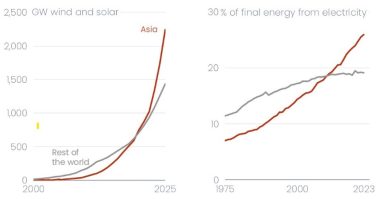
The accelerating rollout of cheaper and more secure alternatives to oil and gas imports turns this assumption on its head. Asia is electrifying five times faster than the West, while ramping up renewable energy capacity faster than the rest of the world (see Figure 1)[1] – undermining demand for oil and gas in the process. Globally, a range of energy scenarios see demand for oil and gas peaking by 2030 and the mid-2030s, respectively. Reflecting this, investment in clean energy systems already roughly doubles that in fossil fuels.[2] The rise of consolidation among oil and gas majors globally suggests many companies are waking up to the immense transformation of the energy system underway.[3]
Figure 1: Asia is running ahead of the rest of the world on electrotech.
Source: Ember (2026)
Crucially, the current Middle East conflict — while increasing the relative attractiveness of Canadian producers today – may undercut the long-term market demand for Canadian hydrocarbons.
Geopolitical tensions appear to be accelerating Asia’s rapid electrification and renewables buildout, as price-sensitive consumers, businesses, and policymakers confront energy affordability and availability challenges stemming from the region’s high dependence on fossil fuel imports. Across Asia, the doubling of China’s solar PV exports in March 2026, the cancellation of certain LNG-related projects, the fast-tracking of renewable and electricity storage systems, and the restarting of nuclear reactors illustrate this shift.[4]
For LNG specifically, a wave of new projects further threatens to compress prices – compounding the energy transition risk of oil and gas demand destruction. With ~254 million tonnes of LNG expected to come online by 2030, futures markets are seeing LNG prices of $10/MMBtu and below as soon as 2028.[5] At this price, our analysis suggests under-construction and proposed LNG projects in Canada may fail to compete. Simultaneously, LNG price volatility is likely to deter importers from sinking significant capex into regasification infrastructure.
Market uncertainty in coming decades casts doubt on the value-add of potential new oil and gas projects in Canada…
Structural market uncertainty matters to companies and their investors. Investment decisions made today lock oil and gas companies – and their financiers – into projects whose economics depend largely on oil and gas prices decades into the future. Findings from CTI’s Fading Fortunes suggest the extent of this exposure varies: certain Canadian producers face relatively greater risk of value destruction from new projects than others, depending on how cost-competitive their project portfolios are.
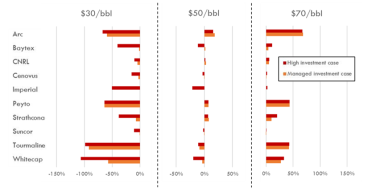
Figure 2 summarises the impact of different investment strategies on the upstream oil and gas value of 10 of Canada’s largest producers. The analysis assesses whether investment in new projects adds or destroys value by comparing two growth investment cases against a Depletion case in which no new projects are developed. The “High” investment case (red) reflects business-as-usual “BAU” investment in new projects; the “Managed” investment case (orange) restricts new investment to lower-cost options.
The analysis tests these investment cases under a fast, moderate, and slow transition scenario. The commodity prices tied to these scenarios – while lower than the elevated prices of the 2026 energy crisis – reflect potential long-term prices in the 2030s as markets normalise and oil and gas demand substitution continues.
Figure 2: NPV impact of High and Managed investment relative to Depletion, by Canadian O&G companies under a range of commodity price scenarios.
Sources: Rystad Energy, CTI analysis
Across these 10 companies, downside risk exposure under a fast transition scenario is approximately double the upside potential under a slow transition scenario. Downside risk exposure is particularly pronounced for companies reliant on new gas projects to drive future production.
…yet, financial stakeholders are making long-duration capital bets based on market conditions today.
Canada is continuing to commit capital to assets with multi-decade lives, based on expectations of Asian demand growth for oil and gas imports – precisely as Asia expands clean and homegrown alternatives. Capital decisions are being made based on the extraordinary oil and gas market of 2026, when the financed infrastructure must withstand markets that may look very different through the 2030s and 2040s.
An examination of Canada’s banking system illustrates how this bet is being financed. Canada’s Big Five banks (comprising Royal Bank of Canada “RBC”, Toronto-Dominion Bank “TD”, Canadian Imperial Bank of Commerce “CIBC”, Bank of Montreal “BMO”, and Scotiabank) remain among the top financiers globally in terms of lending and underwriting of debt and equity issuances in the oil and gas sector.[6] This financing is often well above average relative to the banks’ size, compared to their peers. Moreover, the rollback of oil and gas financing policies and emissions targets at several of the Big Five suggests a growing appetite to continue financing oil and gas expansion well into the future.
At a high level, Canada’s Big Five banks appear to have diverged sharply in their response to transition risk exposure from oil and gas financing in recent years. RBC and Scotiabank dropped their 2030 emission reduction targets (and the latter dropped its 2050 net-zero target); simultaneously, they increased their financing of oil and gas expansion companies by ~8% and ~2%, respectively, from 2024 to 2025. In contrast, CIBC, TD, and BMO Financial Group decreased such financing by ~9%, 7%, and 20%, respectively, over this period.
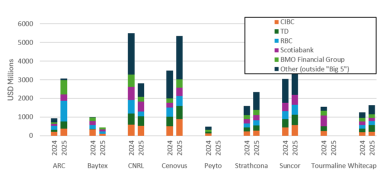
However, these headline figures do not capture more granular shifts in financing. A CTI analysis of data from the Banking on Climate Chaos Coalition shows upstream expansion financing for nine of Canada’s largest upstream producers in 2024 and 2025, broken down by bank (Figure 3).[7]
Figure 3: Big Five and other bank financing of oil and gas expansion across large oil and gas companies in Canada (2024-2025).
Sources: Banking on Climate Chaos Coalition, CTI analysis
Viewing upstream expansion-related bank financing (Figure 3) alongside the risk profile of upstream project portfolios (Figure 2), it is evident that all of the Big Five have increased upstream expansion financing for certain companies with high-risk upstream project portfolios.
Among Canadian oil and gas companies assessed by CTI, Big Five financing increased most sharply for ARC Resources. Each bank increased its upstream expansion financing for ARC by between 80% to 670%, contrasting sharply with the ~60% reduction in financing by non-Big Five banks. CTI analysis suggests a high level of downside risk exposure within ARC’s upstream project portfolio: under a fast-paced transition scenario, ARC’s potential new upstream projects risk reducing upstream value by ~60%, relative to a scenario in which the company invests in no new projects. Big Five financing also increased for Strathcona and Whitecap, despite the significant downside risk exposure of their project portfolios.
Risk from upstream oil and gas expansion exposes a broad range of stakeholders, with cascading effects.
The financial risk exposure of oil and gas expansion in Canada extends well beyond oil and gas companies and their financiers. The same commodity price assumptions that expose bank financing to risk also expose equity investments and government revenues.
Ultimately, value at risk from new upstream projects puts pressure on the credit quality of Canadian oil and gas companies, with potential implications for national financial stability and lending to the broader Canadian economy.
Risk of asset stranding within the upstream oil and gas sector also exposes midstream oil and gas assets – including pipelines – to lower-than-expected throughput volumes and revenues. This risk within midstream activities undermines the financial viability of proposed new pipelines, which may cost Canadian taxpayers tens of billions of dollars.[8]
Continued dependence on the oil and gas sector for economic growth also exposes certain provinces to fiscal risk. Findings from CTI’s Petro-Provinces at Risk suggest a moderate-paced energy transition could eliminate over 80% of Canadian provincial governments’ expected revenue from upstream oil and gas over the next decade. Export Development Canada’s potentially growing exposure to major projects puts federal tax dollars at risk as well.
What does this mean for Canadian stakeholders?
- For policymakers and regulators: Ottawa and Alberta’s push for oil and gas expansion appears disconnected from the economic reality facing the sector. Expanding the oil and gas system is very different from – and riskier than – continuing to operate existing assets alone. Consider whether the national strategy reflects a realistic set of assumptions around long-term market conditions, and what role the country could play in an emerging electrotech system. Further diversification of the economy could reduce exposure to transition risk from the oil and gas sector while offering opportunities to lead in a new energy landscape.
- For banks: As key markets rapidly transform, can lending portfolios withstand a faster-than-anticipated energy transition? Consider how to adjust financing to a future where demand for oil and gas may be significantly lower than today.
- For investors: Asset managers should assess and make investment decisions based on a realistic range of long-term demand scenarios. Pension funds are particularly exposed to transition-related financial risks from oil and gas portfolio companies, due to the decades-long time horizon of their investment portfolios.
Conclusion
The oil and gas sector has played an important economic role in Canada for many years. But the revenues and jobs it generated in the past are not guaranteed in the future. As technology changes exponentially, fossil fuel expansion in Canada leaves oil and gas companies and their financial stakeholders exposed to a growing risk of value destruction. Prime Minister Carney and financial stakeholders must decide whether they are willing to bet Canada’s fortunes on static assumptions, and what role Canada will play in an emerging energy system of the future.
________________________
[1] Ember, Electric Asia (June 2026) pp. 12, 15.
[2] IEA, World Energy Investment 2026 (2026), p. 202.
[3] CTI, The Quiet Retreat: Why the oil and gas industry is implementing its own decline, even as the IEA resurrects an old growth scenario (November 2025).
[4] Institute for Energy Economics and Financial Analysis (IEEFA), The current state of LNG in Canada (July 2026).
[5] IEEFA, The current state of LNG in Canada (July 2026).
[6] Banking on Climate Chaos Coalition, Banking on Climate Chaos 2026 (May 2026), p. 25.
[7] Analysis excludes Imperial Oil due to lack of available data on financing.
[8] Canadian Broadcasting Corporation reports that Canadian taxpayers may potentially cover 90% of the estimated $35.2-$43.7bn cost of a new crude oil pipeline.