






















Key Resources
Looking for more information? Here’s everything you should need.
Webinar Recording (Europe/Asia)

Webinar Recording (Europe/Asia)
Webinar Recording (Americas)
Webinar Recording (Americas)
Supporting Slides (Europe/Asia)
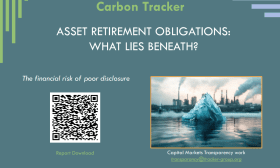 Download
Supporting Slides (Americas)
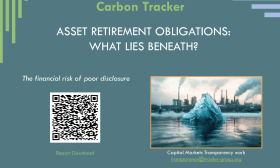 Download
Launch Webinar (Europe/Asia Session)

Launch Webinar (Europe/Asia Session)
4 February | Online | 08:00 UK | 15:00 Hong Kong | 16:00 Sydney Join us for a 60-minute webinar exploring...
Read MoreLaunch Webinar (Americas Session)
Launch Webinar (Americas Session)
4 February | Online | 16:00 UK | 11:00 New York | 08:00 San Francisco Join us for a 60-minute webinar...
Read MorePress Release
Press Release
New research reveals major gaps in disclosure of decommissioning liabilities for oil and gas...
Read MoreExecutive Summary
AROs: Transparency Scorecard Methodology
Key Quotes
Barbara Davidson, Head of Capital Markets Transparency at Carbon Tracker: “Our analysis shows that oil and gas companies are routinely failing to provide sufficient information needed by investors to assess the scale and timing of, and the impact of uncertainties on, companies’ decommissioning obligations. Investors cannot properly evaluate the impact of future ARO payments on a company’s liquidity, compare companies across jurisdictions or understand the risks embedded in these long-term liabilities without transparent assumptions, payment schedules and sensitivities. Yet our findings also show that better disclosure is achievable. As the energy transition accelerates, incomplete reporting leaves markets exposed to growing financial and regulatory risks.”
Why inconsistent asset retirement obligation disclosures leave investors exposed to hidden risk
Oil and gas companies in the UK, Canada and Australia are failing to fully disclose the costs of decommissioning their fossil-fuel-related infrastructure, leaving investors with incomplete and non-comparable information. Our new report, Asset Retirement Obligations: What Lies Beneath? reveals significant variation in the quality and completeness of reporting information, despite companies in all three jurisdictions using the same international accounting standards.
Our report makes the case for improving transparency and comparability in how oil and gas companies in the UK, Canada, and Australia report information about obligations to decommission their fossil fuel infrastructure. This includes information underlying the balance sheet liability, including estimated costs and timing. Currently, gaps in reporting expose investors to financial and regulatory risks.
Key Findings
Overall quality of ARO disclosures is poor and seems to vary depending on jurisdiction
Carbon Tracker assessed 38 oil and gas companies’ financial statements using 15 disclosure metrics. While each metric was achievable – with at least one company providing some of the relevant information – overall disclosure is poor, leaving investors with incomplete and non-comparable information. In the UK, oil and gas companies disclosed on average 45% of the relevant information required to assess the full extent of asset retirement obligations. This dropped to an average of 41% for Canadian companies, and just 19% for Australian companies.
Companies subject to assessment follow the same International Financial Reporting Standards (IFRS), issued by the International Accounting Standards Board (IASB). But the extent of the variation between jurisdictions points to a potential correlation between more observable regulatory activity in the UK and Canada (compared with Australia), and the quality of disclosure.
Recommendations
In 2023, Carbon Tracker estimated that decommissioning existing oil and gas infrastructure in the U.S. alone would cost over $1.2 trillion, and that total global costs could be four times as large. As the energy transition gathers pace, the resources to pay for clean-up may be needed sooner than planned, while production revenue may not be available as a source to cover these costs.
More regulatory scrutiny is urgently needed to improve transparency about how oil and gas companies report decommissioning and clean up obligations (and the related liabilities) in their accounts.
The report recommends that financial market regulators:
- Prioritise transparency of decommissioning liabilities in supervision and oversight
- Ensure investors can understand the scale, timing of, and impact of uncertainties on asset retirement obligations
- Encourage companies to adopt consistent, comprehensive reporting practices
Related research on AROs: https://carbontracker.org/tag/aro/