
Assessment of remuneration plans disclosed in 2026
In our latest update on executive remuneration in oil and gas, we explore the most recent executive remuneration plans to analyse the influence of metrics driving management decisions at 30 of the largest upstream and integrated players in the industry.
In the last five years, investment in transition technologies nearly doubled to $2.3tn, renewable capacity rose by 70% and electric vehicle sales jumped from 5% of all new sales to 20%.[1] Renewables now account for a half of global electricity generation capacity.[2] Despite recent shocks in energy markets – and in some cases partly because of them – total energy demand is likely to prop up electrification efforts and put oil and gas demand into structural decline.[3]
How companies react to these long-term trends depends largely on the style and priorities of their chief executive officers, who are in turn motivated by the incentives built into their remuneration plans.[4]
CEO priorities can be gleaned from metrics used to determine performance-based pay
Our analysis focuses on performance-based variable pay, which typically accounts for the largest share of total remuneration.[5] We isolate and weight individual metrics, or incentives, in target payouts and group them into one of four categories:
- Direct growth – metrics that explicitly incentivise growing production volumes, e.g. those measuring growth in oil and gas reserves and output.
- Indirect growth – metrics that implicitly encourage increasing oil and gas reserves and production, even if additionally influenced by other factors, e.g. those measuring income levels or cash flows.
- Growth neutral – metrics that can be achieved regardless of strategic direction, e.g. those measuring safety events, financial ratios, or operational emissions.
- Transition response – metrics that can incentivise a pro-active approach to the energy transition in three different ways: diversification, distribution, or production decline.
Our analysis of compensation plans from 2024, the latest year for which we have a comprehensive dataset, is summarised in a downloadable flash note on this webpage.
Below, we provide an assessment of remuneration plans from 2025 and, if disclosed, 2026. We will continue to update this dataset as new disclosures are made, prioritising companies approaching their AGMs.
Overview of remuneration plans from 2025
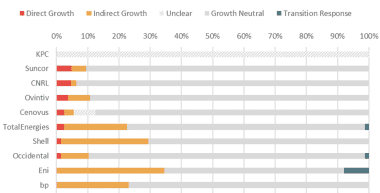
So far, we have assessed eight executive remuneration plans that were put in place in 2025 (see Figure 1).
Figure 1. Target performance-based variable pay by metric, 2025
Source: Corporate disclosures, Carbon Tracker analysis
Four of these, namely those at bp, Eni, Shell and TotalEnergies, were disclosed in 2025, i.e. in the year in which they applied.
Compensation plans continued to incentivise output growth, both directly and indirectly
We found direct growth metrics at seven of the nine companies where disclosures have been made in adequate detail.
Geographically, we see direct growth metrics prevailing in Canada, where they accounted for 3-5% of performance-based pay in 2025.
Among Europeans, bp and Eni both removed direct growth metrics from their remuneration plans, in a first for either supermajor in the history of our assessments.
That said, indirect growth metrics proved stickier, featuring in all nine sufficiently disclosed compensation plans. These were especially influential in Europe, accounting for 34% of performance-based pay at Eni, 28% at Shell, 23% at bp and 20% at TotalEnergies.
The industry deprioritised transition response
Previously a fixture at all four European companies, transition response metrics disappeared from compensations plans at bp and Shell. At Eni, their share slid from 19% in 2024 to 8% in 2025, making room for growth-neutral incentives.
None of the Canadian companies incorporated transition response into executive remuneration. So far, we see an industry moving away from incentivising action on the energy transition.
Overview of 2026 remuneration plans
Most companies choose to disclose their remuneration plans retrospectively, in the year after they take effect. While still subject to investor approval, they provide limited insight into the current thinking of the senior management.
Ex ante disclosure of remuneration plans signals a higher degree of transparency in corporate governance and provides investors with crucial intelligence as they head to the AGMs to have their Say on Pay.
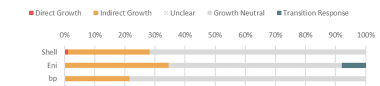
In this section, we will be providing an overview of remuneration plans that have been put in place this year. So far, we have evaluated compensation plans at bp, Eni and Shell (see Figure 2).
Figure 2. Target performance-based variable pay by metric type, 2026
Source: Corporate disclosures, Carbon Tracker analysis
All three companies continue to use incentives to grow production, though only Shell still uses direct growth metrics.
Bp’s remuneration plan remains virtually unchanged, despite the strategic reset
Bp’s compensation plan remains virtually unchanged compared with 2025 – even after several changes aimed at simplifying the company’s executive remuneration policy (see Table 1).
Table 1. Breakdown of bp’s performance-based variable pay by metric type, 2024-2026
| Year | Direct Growth | Indirect Growth | Unclear | Growth Neutral | Transition Response |
| 2024 | 4% | 31% | 0% | 56% | 9% |
| 2025 | 0% | 23% | 0% | 77% | 0% |
| 2026 | 0% | 22% | 0% | 78% | 0% |
Sources: bp, Annual Report 2024, Annual Report 2025, Annual Report 2026; Carbon Tracker analysis
Despite the strategic reset, based among other things on “growing the upstream”,[6] direct growth metrics have remained absent. Instead, executive pay is now linked to measures like relative total shareholder return, return on capital, and adjusted free cash flow.
One notable change is the removal of the emission reduction metric from the annual bonus – the short-term component of performance-based pay. Bp believes emission reductions are “more appropriately evaluated through our performance share award rather than the annual bonus”.[7]
While the emission reduction metric has survived in the long-term incentive plan, it is not aligned with the goals of the Paris Agreement.[8] We note that bp’s best corporate emission target has also failed to meet all key hallmarks of a Paris-aligned goal (for more information, see Absolute Impact 2026).
We also find that while the long-term incentive plan runs for six years, performance is only assessed over the first three. This means the CEO can still receive full pay even if progress is later reversed, as the plan’s clawback provisions do not allow payouts to be reduced if emissions targets are not ultimately maintained.
Engagement Questions
Some oil and gas companies will soon begin locking in incentive plans that will stay in effect through the end of the decade. With hydrocarbon demand set to peak around that timeframe, investors should check whether these plans align with corporate strategies as well as their own investment mandates.
Key questions that investors engaging with oil and gas companies may ask include:
- For companies continuing to use direct growth metrics, what scenario and assumptions have been used to justify their inclusion?
- For companies that rely extensively on indirect growth metrics, is there a case for replacing such metrics with industry-benchmarked relative measures?
- For companies that fail to disclose partially or fully their remuneration policies, will they provide more transparency on those?
For a more granular overview of executive remuneration in oil and gas, including analysis of year-on-year changes in each metric category as well as five-year trends for individual companies, please contact saidrasul.ashrafkhanov@carbontracker.org.
—————————————————————–
[1] BloombergNEF, BloombergNEF Finds Global Energy Transition Investment Reached Record $2.3 Trillion in 2025, Up 8% from 2024 (26 January 2026); IRENA, Renewable capacity highlights (31 March 2026); IEA, Global EV Outlook 2025 (2025).
[2] Reuters, Exclusive: Renewables grew to almost 50% of global electricity capacity in 2025 after solar boost (31 March 2026).
[3] Bloomberg News, China Clean Tech Exports Jump as Iran War Spurs Demand (18 April 2026).
[4] Carbon Tracker, Paying with Fire (2019); Fanning the Flames (2020); Groundhog Pay (2020); Crude Intentions (2022); Crude Intentions II (2024); Crude Intentions III (2025).
[5] Carbon Tracker, Crude Intentions III (2025).
[6] bp, Annual Report 2025, p.8.
[7] bp, Annual Report 2025, p.8.
[8] As assessed in our dedicated analysis of corporate emission targets Absolute Impact 2026.