Key Resources
Press Release
 Read More
Key Quotes
The Economic Benefits of Pro-Electric Vehicle Policy
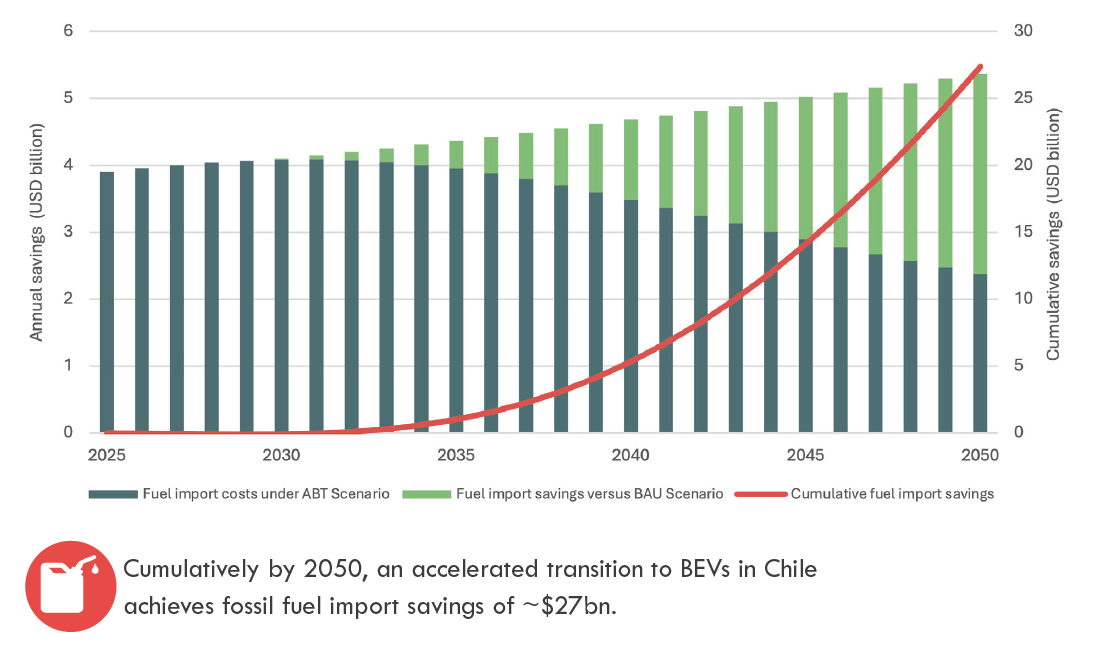
Chile could save approximately US$27 billion in cumulative fuel import costs by 2050 by accelerating its transition from internal combustion engine (ICE) vehicles to battery electric vehicles (BEVs), according to new Carbon Tracker analysis.
The report assesses the economic and financial consequences of continued ICE dependence, including exposure to international oil prices, transport costs, air pollution and climate-related damages. It finds that Chile is well positioned to accelerate electrification, given its renewable electricity resources, critical-mineral production and progress in electric public transport. The report recommends maintaining Phase 2 of Chile’s vehicle efficiency standards, alongside binding zero-emission vehicle sales requirements, targeted fiscal measures and investment in charging infrastructure.
Key findings
Under an Accelerated BEV Transition scenario, compared with business as usual, Chile could by 2050:
- Avoid approximately 600 million barrels of oil equivalent in cumulative fossil-fuel consumption.
- Save approximately US$27 billion in cumulative fuel import costs.
- Generate US$493 million in cumulative health-related economic benefits through lower PM₂.₅ and NOₓ emissions.
- Avoid US$7-150 billion in global climate-related economic damages, depending on the social discount rate applied.
CHILE ROAD TRANSPORT FUEL IMPORT SAVINGS FROM AN ACCELERATED BEV TRANSITION – ABT VERSUS BAU SCENARIOS ($)
Source: Carbon Tracker calculations, CALSTART.
What the data shows
Chile imports almost all its crude oil, while transport accounts for 57% of national oil consumption. Under a business-as-usual scenario, cumulative road transport fuel import costs could reach almost US$120 billion by 2050. An accelerated transition to BEVs could reduce Chile’s annual transport fuel import costs by as much as 56% in 2050 compared with business-as-usual, while limiting exposure to international oil-price volatility.
BEVs already offer an operating-cost advantage. Based on the report’s fuel-price and charging assumptions, driving a BEV in Chile costs approximately 50% less per kilometre than a petrol car and 20% less than a diesel car. Yet the higher upfront purchase price remains a barrier to wider adoption.
Chile has made substantial progress in electrifying public transport, particularly in Santiago, but BEVs accounted for only around 3.5% of new light- and medium-duty vehicle sales in the first seven months of 2026. The country’s electricity supply is already almost two-thirds renewable, while its copper and lithium resources give it an important position in global EV supply chains.
The report also quantifies the long-term economic costs of continued ICE vehicle sales. Each new vehicle locks in future fuel consumption and associated health and climate impacts, with estimated lifetime costs ranging from approximately US$7,500 for a passenger car to US$232,000 for a heavy-duty truck.
Recommendations
The report identifies four policy priorities to support Chile’s zero-emission vehicle sales targets:
- Maintain Phase 2 of Chile’s vehicle efficiency standards: Retain the scheduled increase under the Energy Efficiency Law (Ley N° 21.305), which raises the required fleet-average efficiency for new light-duty vehicles from 18.8 km/Lge in 2024-2026 to 22.8 km/Lge in 2027-2029. The fleet-average approach gives vehicle importers flexibility to meet the standard across the models they sell, encouraging the supply of more efficient and electric vehicles.
- Introduce binding supply-side regulations: Establish enforceable zero-emission vehicle sales requirements, building on existing vehicle efficiency standards and Chile’s electromobility targets to progressively reduce the share of new ICE vehicle sales.
- Reform vehicle taxation: Introduce targeted fiscal incentives to address the upfront cost of BEVs, including a revenue-neutral feebate system that uses charges on higher-emission vehicles to support electric vehicle purchases, alongside differentiated registration fees and targeted commercial depreciation allowances. These measures could also help reflect the wider health and climate costs of ICE vehicles.
- Expand charging infrastructure: Coordinate investment in public charging networks, particularly outside Santiago, along major freight corridors and at commercial fleet depots, with public co-investment prioritised where infrastructure gaps constrain EV adoption.
The report calls for coordinated action across the ministries responsible for transport, energy, finance and the environment to support implementation.
The full Leapfrog to Electric: Chile report, including the economic analysis, modelling assumptions and policy recommendations, is available to download free of charge. Log in or register at the top of this page to access it.
Lea la versión en español y descargue el informe [LINK]
This report was published in association with Centro de Movilidad Sostenible (CMS).
Leapfrog to Electric: Chile is the third report in Carbon Tracker’s series examining the economic and financial benefits of accelerated electric vehicle adoption in emerging economies. Earlier studies found potential cumulative fuel import savings by 2050 of up to US$250 billion in Brazil and approximately US$40 billion in Colombia.