Key Resources
Webinar Recording

Webinar Recording
Supporting Slides
Launch Webinar

Launch Webinar
Read MorePress Release
Press Release
Read MoreKey Quotes
Why the Truck EV Transition is Closer Than Expected
Heavy-duty transport has long been considered as one of the hardest sectors to electrify. Carbon Tracker’s analysis finds that this assumption is increasingly at odds with the economics of commercial freight. Falling battery costs, manufacturing scale and improving operating economics are bringing battery-electric trucks towards total cost of ownership (TCO) parity with diesel across major markets, with key tipping points expected by the early 2030s.
Once parity is reached, adoption is unlikely to proceed gradually. The analysis indicates that electric truck sales can accelerate rapidly along a non-linear S-curve, creating transition risks for manufacturers with large exposures to internal combustion technology and opportunities for companies better positioned for an increasingly electric market.
China provides an early indication of the speed at which this transition can unfold. Battery-electric trucks accounted for more than 30% of Chinese heavy-duty truck sales in 2025, up from around 1% in 2021, demonstrating how quickly market share can shift once commercial economics become favourable.
Key findings
- Heavy-duty freight could electrify sooner than consensus assumptions suggest. China’s battery-electric truck market has already moved from around 1% of sales in 2021 to more than 30% in 2025, providing a real-world example of how quickly adoption can accelerate.
- Total cost of ownership, rather than regulation alone, will determine the pace of the transition. As battery costs fall and operating economics improve, battery-electric trucks are expected to reach or surpass diesel on TCO across major markets by the early 2030s.
- The main investment risk lies in the speed of adoption after cost parity is reached. The modelling indicates a steep S-curve, meaning diesel margins, legacy manufacturing assets and incumbent market positions could come under pressure before electric trucks become the majority of new sales.
- China is likely to shape the global competitive landscape as well as its domestic market. Its rapid electrification is helping manufacturers build scale, reduce costs and develop technologies that can support expansion into international freight markets.
- Electrification is changing the basis of competition between truck manufacturers. Electric-first players and non-traditional competitors are gaining ground through different manufacturing models, software architectures, supply chains and technologies such as battery swapping, reducing the value of some incumbent advantages built around internal combustion platforms.
Graphs:
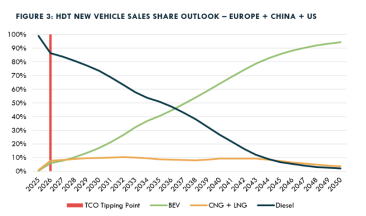
Figure 1: Battery-electric heavy-duty trucks are projected to gain market share rapidly as TCO parity is reached. China has already crossed the tipping point, while Europe and the US are projected to reach parity by around 2030. Across the three markets, BEVs are projected to become the dominant new heavy-truck powertrain in the late 2030s. Figure Source: University of Exeter FTT Model, Carbon Tracker.
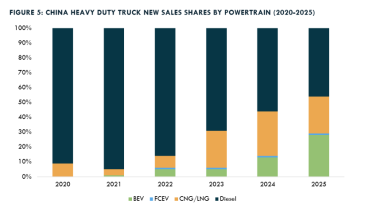
Figure 2: China provides an early indication of how quickly the heavy-duty truck market can change. New energy vehicles – predominantly battery-electric trucks – accounted for around 30% of new heavy-duty truck registrations in 2025, compared with a small share only four years earlier. Source: IEA analysis based on CATARC.
What the data shows
Carbon Tracker uses outputs from the University of Exeter’s Future Technology Transformations model, calibrated with Carbon Tracker’s proprietary market, asset and cost data, to assess how heavy-duty vehicle markets could evolve as battery-electric trucks approach TCO parity.
The analysis focuses on two questions: when the commercial economics are likely to trigger faster adoption, and which manufacturers are best positioned for that transition.
Between 2020 and 2025, the TCO gap between electric and diesel heavy trucks narrowed across major freight markets. The modelling indicates that once electric trucks become cheaper to operate over their lifetime, adoption can accelerate rapidly rather than follow a gradual, linear trajectory.
This matters because financial markets can begin repricing companies before electric trucks become the majority of new sales. Diesel margins, manufacturing utilisation and the value of legacy assets may come under pressure earlier in the transition, particularly where manufacturers have been slow to scale electric platforms or adapt their supply chains.
China also shows that the competitive effects extend beyond domestic sales. As Chinese manufacturers build scale, reduce costs and expand internationally, incumbent truckmakers in other regions face growing competition alongside the technological transition itself.
Recommendations for investors
- Stress-test automotive investments against dynamic cost-parity scenarios that account for battery costs, energy prices, utilisation and route economics, rather than relying primarily on regulatory targets or linear sales forecasts.
- Assess transition risk based on the speed of adoption after TCO parity is reached, as diesel margins, manufacturing utilisation and legacy asset values may come under pressure before electric trucks become the majority of new sales.
- Examine whether manufacturers have credible plans to scale electric platforms, adapt manufacturing capacity, strengthen battery and supply-chain strategies, and compete with electric-first entrants.
- Use active stewardship to test how manufacturers’ capital allocation and product strategies perform under faster electrification scenarios, including how they plan to manage declining demand for internal combustion platforms.
- Factor growing competition from Chinese manufacturers into valuation and strategy assessments as domestic scale, lower costs and expanding international presence increase competitive pressure in global truck markets.