Key Resources
Press Release
Press Release
Read MoreKey Quotes
The economic benefits of pro-electric vehicle policy in Brazil
Accelerated electric vehicle (EV) adoption in Brazil could save up to US$¼ trillion (R$ 1.39 trillion) in cumulative fossil fuel import costs through 2050, reduce deaths from pollution, and avoid at least US$75 billion in climate damages. Imported transport fuels are a growing source of risk to Brazil’s economic and energy security. Under current policy settings, diesel and petrol import costs could rise sharply, increasing exposure to price volatility and adding pressure to the balance of payments and public finance.
Brazil is well positioned to lead the EV transition, with a low-carbon electricity grid, abundant battery mineral resources, and a strong domestic automotive industry. Electricity is already significantly cheaper than petrol, making EVs cost-competitive for consumers – and consumer demand for battery electric vehicles (BEVs) is expected to soar as fuel savings are realised. Brazil’s adoption of flex-fuel (a mix of ethanol and petrol) over the past decades has lowered oil imports but not eliminated fossil fuel dependence in transport; electrification remains the best path to long-term energy security, lower costs, and full decarbonisation.
Key findings
- In 2024, Brazil spent nearly US$10 billion on diesel and petrol imports.
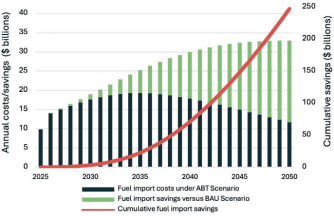
- Under a business-as-usual pathway, annual import costs could exceed US$30 billion by 2050.
- An accelerated BEV transition could avoid consuming 7.7 billion barrels of oil equivalent (BOE) of transport fuel, saving US$¼ trillion in cumulative fossil fuel import costs (see figure below).
- Reduced air pollution could prevent an estimated 1,400 premature deaths and generate US$500 million in cumulative health savings by 2050.
- Lower transport emissions could avoid at least US$75 billion in climate-related economic damages by 2050.
What the data shows
Continued ICE vehicle sales create long-term economic, health, and climate costs – and plans to expand crude oil and refining capacity risk stranding capital as global oil demand and prices become more volatile. Meanwhile, the global shift towards BEVs is reducing risk: battery costs have fallen sharply since 2013, and supply chains are strengthening. For Brazil, that combination supports faster electrification and opens pathways for technology transfer, domestic manufacturing, and regional value chains.
Recommendations
The report calls on the Brazilian government to implement a co-ordinated BEV policy to unlock economic, environmental, and strategic benefits. It recommends:
- Boosting investment in transport electrification.
- Leveraging the political and economic opportunity for Brazil to be a global leader in the energy transition.
Download the report
Explore the full report for a detailed analysis of how accelerated electric vehicle adoption could enhance Brazil’s energy security, reduce fiscal and climate risks, and deliver public-health gains. Use the download button at the top of this page.