Key Resources
Press Release

Press Release
Read MoreKey Quotes
The economic benefits of pro-electric vehicle policy in Colombia
Accelerated battery electric vehicle (BEV) adoption in Colombia could save around US$40 billion in cumulative fossil fuel import costs by 2050, while also reducing pollution-related health costs and avoiding climate-related economic damage. Carbon Tracker finds that, under a business-as-usual pathway, Colombia’s cumulative road transport fuel import bill could reach US$226bn by 2050.
Colombia has several structural advantages that could support a faster shift to electric mobility. The report points to a relatively low motorisation rate, an electricity system in which an average of 72% of supply has come from hydropower since 2000, and limited exposure to legacy domestic automotive manufacturing. It also finds that electricity remains cheaper than petrol or diesel for road transport.
Key findings
In its accelerated BEV transition scenario for Colombia, finds that by 2050 the country could:
- avoid 600 million barrels of oil equivalent in fossil fuel use
- save around US$40 billion in cumulative fuel import costs
- generate US$40 million in cumulative health cost savings through lower PM2.5 and NOx emissions
- avoid US$2.3bn to nearly US$35bn in climate-related economic damages, depending on the discount rate applied. In the central 5% discount-rate scenario, cumulative social cost of carbon benefits exceed US$8.5bn.
The report also finds that every new ICE vehicle sold locks in long-term economic costs. Carbon Tracker estimates the lifetime cost per new ICE vehicle at US$5.8k for a passenger car, US$119.6k for a medium-duty vehicle, US$278.0k for a heavy-duty vehicle and US$349.6k for a bus.
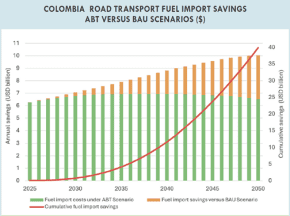
Cumulatively by 2050, an accelerated transition to BEVs in Colombia achieves fossil fuel import savings of $40 billion.
What the data shows
The report presents continued ICE dependence as a long-term economic liability. Transport accounted for 75% of Colombia’s oil consumption in 2023, with over 25% of those fuels imported. As motorisation rises and refining capacity remains constrained, Carbon Tracker finds that imports could account for 59% of gasoline supply and 22% of diesel supply by 2040. Under the business-as-usual scenario, annual import costs could exceed US$10bn, reaching US$226bn cumulatively by 2050.
The report also argues that Colombia’s current ICE-dependent system is fiscally draining. It estimates fossil fuel subsidies at around US$6.8bn in 2025, compared with US$6.3bn in government revenues from fossil fuel sales, implying a net fiscal deficit of US$0.5bn.
Colombia’s low motorisation rate means it still has room to electrify a growing fleet before deeper ICE lock-in takes hold. The report puts passenger car ownership at about 72 cars per 1,000 people, compared with more than 200 in Brazil, Mexico and Chile.
At the same time, the report identifies a policy gap. Colombia already has some BEV incentives in place, including a 1% annual vehicle tax rate for EVs, compared with 1.5-3.5% for ICE vehicles, and a 10% reduction in road-worthiness testing costs. But it does not yet have binding supply-side regulation to phase down ICE sales.
Recommendations
The report calls on the Colombian government to adopt a more co-ordinated BEV strategy to capture the economic, fiscal and public-health benefits of faster electrification. It points to three broad policy priorities BEV strategy to capture the economic, health and energy-security benefits of faster electrification. It recommends:
- strong supply-side regulation, including zero-emission vehicle mandates, ICE vehicle import bans or progressive fuel economy standards
- co-ordinated fiscal reform that penalises pollution and rewards efficiency
- targeted charging infrastructure rollout, including freight corridors and public transport charging depots.
It also argues that progress will depend on alignment across the relevant ministries, including transport, energy, environment, finance and industry.
Download the report
Explore the full report for detailed analysis of how faster BEV adoption could reduce Colombia’s fuel import dependence, lower long-term fiscal pressure, cut pollution-related health costs and improve economic resilience. Use the download button at the top of this page.
Lea la versión en español y descargue el informe.
This report was produced in association with Polen Transiciones Justas.